
 Image 1 of 1
Lucenea Studios
About my seed pots
The idea of creating seed pots was inspired by the traditional Acoma seed pots of New Mexico. My shapes are inspired by nature.
An Acoman potter told the story of how traditional seed pots were created to hold the seeds for spring planting. Each was pinch pot formed and the belly expanded by blowing into it. The breath blown into it also contained a wish for the harvest. As these pots became more symbolic and the painted designs more intricate, the wishes grew more expansive to include the whole community.
I fell in love with this idea.
Each of my seed pots contains a wish as well, one close and dear to my heart. With every breath blown in to expand the tiny belly of each pot I add a wish to protect our amazing and breathtaking environment, our parks, trees, rivers, cliffs, oceans, forests, mountains and endless rolling plains.
Though I am one quarter Native American, I was not born or raised with their traditions, rituals or cultures, so although I love the traditional seed pots, I needed to create my own version of these wonderful vessels to express something unique. I looked to nature, as I always do for inspiration and that is where the idea of creating them in seed-like forms came from. I am always amazed how sculptural nature’s seeds are. My seed pots take that hidden beauty held within the traditional pots, the seeds themselves, and expresses it on the outside. Like seeds, I see these little vessels as symbols of fertility and growth, from the tiny acorn comes the magnificent oak.
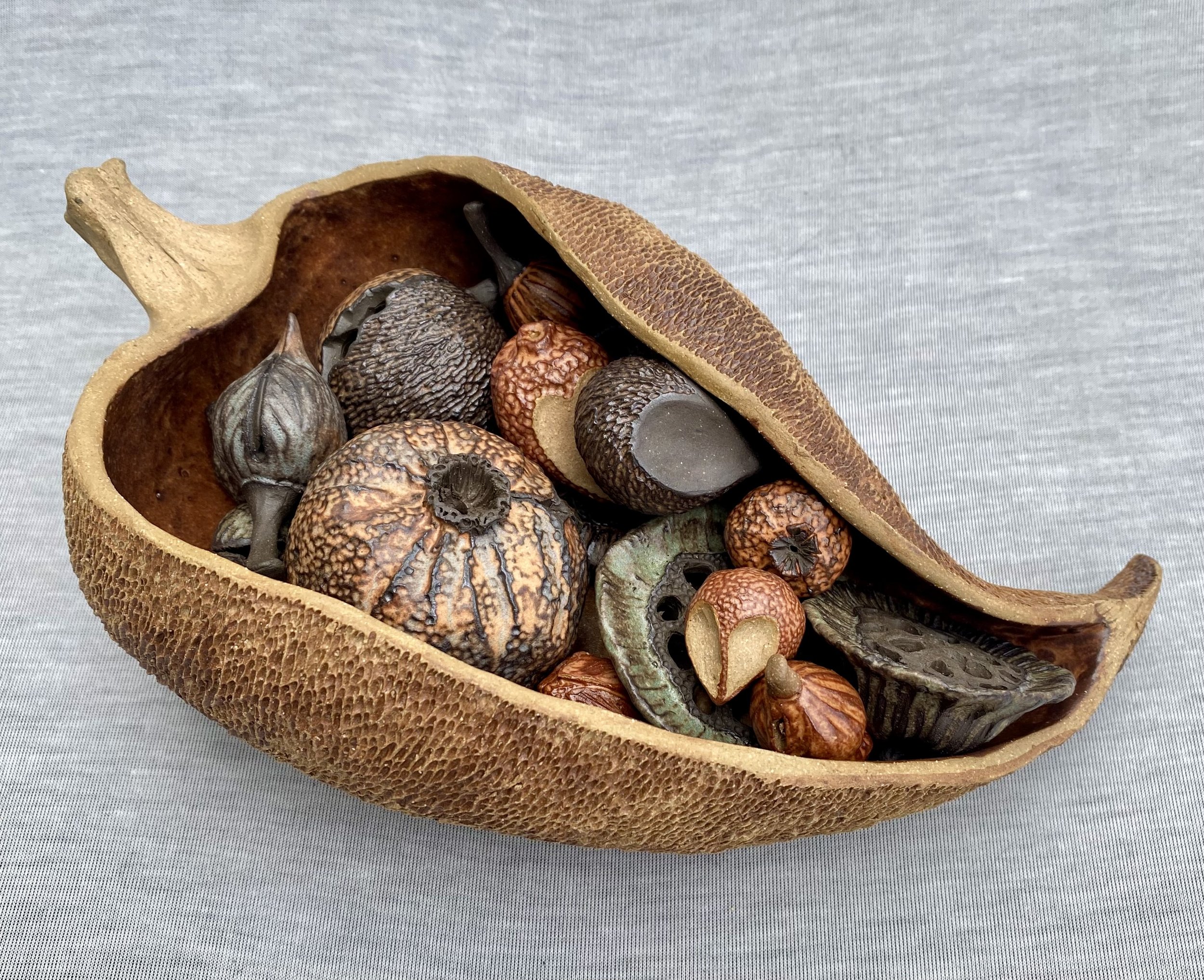
I have recently begun creating little bowls to hold small collections of seed pots. I see them in small clusters. And I usually make them in small clusters as well.
Similar to the Acoma pots, each piece is an original handmade vessel formed through the pinch pot method. As they harden, necks are attached and each surface is sculpted, carved and textured. My clays vary as do the final finishes. Many of these pots are painted with terra sigillata and then hand buffed, giving them a soft and natural feel. Others are partially glazed while some are left completely unglazed revealing the natural beauty of the clay itself.
Saskia G. Van Vactor
Lucenea Studios
About my seed pots
The idea of creating seed pots was inspired by the traditional Acoma seed pots of New Mexico. My shapes are inspired by nature.
An Acoman potter told the story of how traditional seed pots were created to hold the seeds for spring planting. Each was pinch pot formed and the belly expanded by blowing into it. The breath blown into it also contained a wish for the harvest. As these pots became more symbolic and the painted designs more intricate, the wishes grew more expansive to include the whole community.
I fell in love with this idea.
Each of my seed pots contains a wish as well, one close and dear to my heart. With every breath blown in to expand the tiny belly of each pot I add a wish to protect our amazing and breathtaking environment, our parks, trees, rivers, cliffs, oceans, forests, mountains and endless rolling plains.
Though I am one quarter Native American, I was not born or raised with their traditions, rituals or cultures, so although I love the traditional seed pots, I needed to create my own version of these wonderful vessels to express something unique. I looked to nature, as I always do for inspiration and that is where the idea of creating them in seed-like forms came from. I am always amazed how sculptural nature’s seeds are. My seed pots take that hidden beauty held within the traditional pots, the seeds themselves, and expresses it on the outside. Like seeds, I see these little vessels as symbols of fertility and growth, from the tiny acorn comes the magnificent oak.
I have recently begun creating little bowls to hold small collections of seed pots. I see them in small clusters. And I usually make them in small clusters as well.
Similar to the Acoma pots, each piece is an original handmade vessel formed through the pinch pot method. As they harden, necks are attached and each surface is sculpted, carved and textured. My clays vary as do the final finishes. Many of these pots are painted with terra sigillata and then hand buffed, giving them a soft and natural feel. Others are partially glazed while some are left completely unglazed revealing the natural beauty of the clay itself.
Saskia G. Van Vactor